Five Small Experiments to Train a Trailing Plant to Climb or Fill a Shelf
Why try these small experiments?
Trailing houseplants are forgiving and responsive. With a few low-risk, short experiments you can learn whether yours prefers to be guided upward, allowed to spill gracefully, or nudged into a denser, bushier habit. Each experiment here is quick to start, takes a few weeks to show results, and builds a simple skill: interpreting how your plant responds so you can choose the look you prefer.
How to use this sequence
Run the experiments in order. Keep notes or a few phone photos each week. The changes are subtle at first; the point is to learn the plant’s reactions so you can make pleasant adjustments with confidence rather than guessing.
What you’ll need
- Small stakes, a short moss pole, or wall hooks (depending on experiment)
- Soft ties or twine, scissors
- Notebook or phone for weekly notes and photos
- A steady light spot—keep the location consistent through the experiments
Experiment 1 — Baseline: a month of quiet observation
Purpose: learn the plant’s natural habit in your light and routine.
- Leave the plant where it currently lives. Do not prune, tie, or move it.
- Once a week, take one photo from the same angle and jot down: any new growth location, leaf size, stem length, and whether new leaves face up or down.
- After 3–4 weeks, note patterns: does new growth aim upward toward light, or does it trail straight down? Does the plant produce side shoots where older leaves drop?
What it tells you: if growth leans toward light, the plant will likely accept help climbing. If stems grow long and sparse, it may prefer being encouraged to branch with pruning.
Experiment 2 — Gentle pinching to encourage branching
Purpose: learn how responsive the plant is to light trimming.
- Choose one or two stems that are long and unbranched. Using clean scissors or your fingers, pinch just above a node (the small bump where a leaf emerges).
- Repeat the weekly photo and notes routine for 4–6 weeks. Look for new shoots emerging from the node below the pinch.
What to expect: many trailing plants will produce two new side shoots within several weeks. If branching is slow or absent, you may need slightly brighter light to energize regrowth.
Experiment 3 — Add a short support: encourage upward training
Purpose: test whether the plant will climb when given a surface to grip.
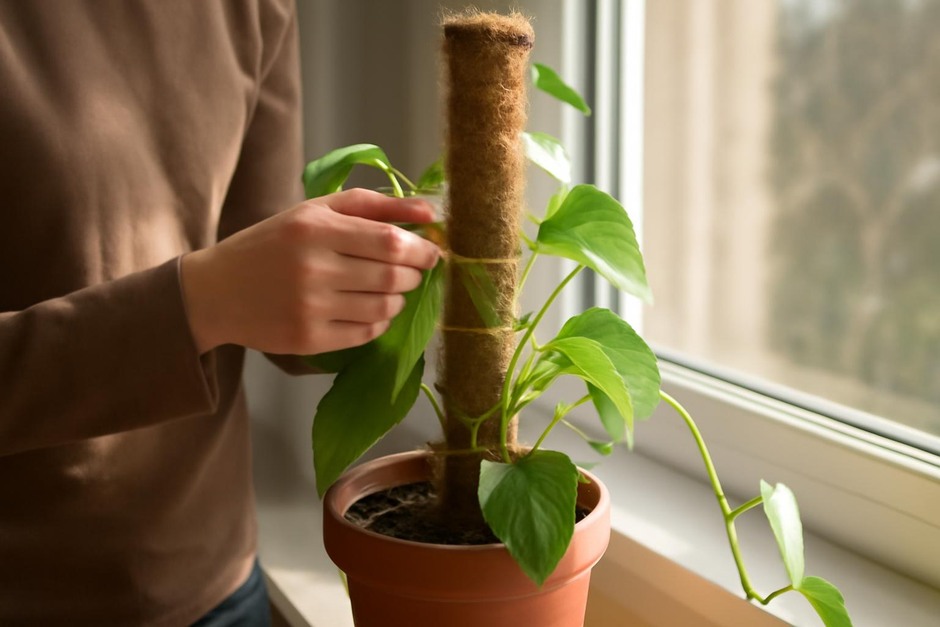
- Install a 12–18 inch moss pole or stake near the plant’s center. Gently tuck or tie a few longer stems to the support so leaves contact the pole.
- Keep ties loose so stems aren’t constricted. Continue weekly photos for 6–8 weeks.
What it tells you: if new growth curls toward and clings to the support, the plant is a good climber. If stems ignore the pole and continue to extend outward, the plant prefers trailing—so remove the support and experiment with fuller mounding instead.
Experiment 4 — Controlled rotation and retraining
Purpose: learn how rotation and gentle repositioning affect symmetry and fullness.
- Rotate the pot a quarter turn every week for a month, or move several longer stems to the opposite side of the pot and tie them in place.
- Photograph weekly and note whether growth evens out or concentrates toward the brightest side.
What to watch: even with rotation, some plants will favor the sunniest direction. Regular rotation encourages round growth; targeted repositioning helps create a fuller front-facing display.
Experiment 5 — Combine pinching and support for a long-term form
Purpose: solidify the look you prefer by combining techniques that worked best in earlier experiments.
- Choose the approach that gave the best results—pinching for fullness, support for climbing, or rotation for symmetry.
- Apply it to the whole plant gradually: pinch selective stems each month and tie new leaders to a support as needed. Keep weekly or biweekly notes for the next 2–3 months.
Result: by combining the most effective small treatments, you will have shaped a sustainable habit—climbing, cascading, or mounding—without stress or dramatic pruning.
Simple success checks
- New nodes and side shoots appearing after pinching mean the plant responds well to pruning.
- Leaves that point toward a pole and stems that shorten indicate willingness to climb.
- More even leaf distribution after rotation shows the plant adapts to gentle repositioning.
These small experiments are designed for a single season—start them in autumn or spring for the calmest results. The goal is gradual learning: when you can read the signals your plant sends, shaping it becomes a quiet, enjoyable part of daily room life.